

Fine Dining Steak Explained: Dry-Aging, USDA Prime, and What to Know

Key Takeaways
- Four things separate a real fine dining steak from an expensive disappointment: USDA Prime grade, dry-aging, the right cut, and a kitchen that handles high direct heat. Miss any one and the result drops.
- Dry-aging concentrates flavor and tenderizes the meat through controlled enzymatic breakdown over 21-45 days. Most chain steakhouses skip it and wet-age in vacuum bags — the difference is significant.
- A fine dining Italian steakhouse like Sofia in Englewood runs USDA Prime, dry-ages the cuts, and finishes them in a wood-fired oven — the three markers most diners can't get from a chain steakhouse.
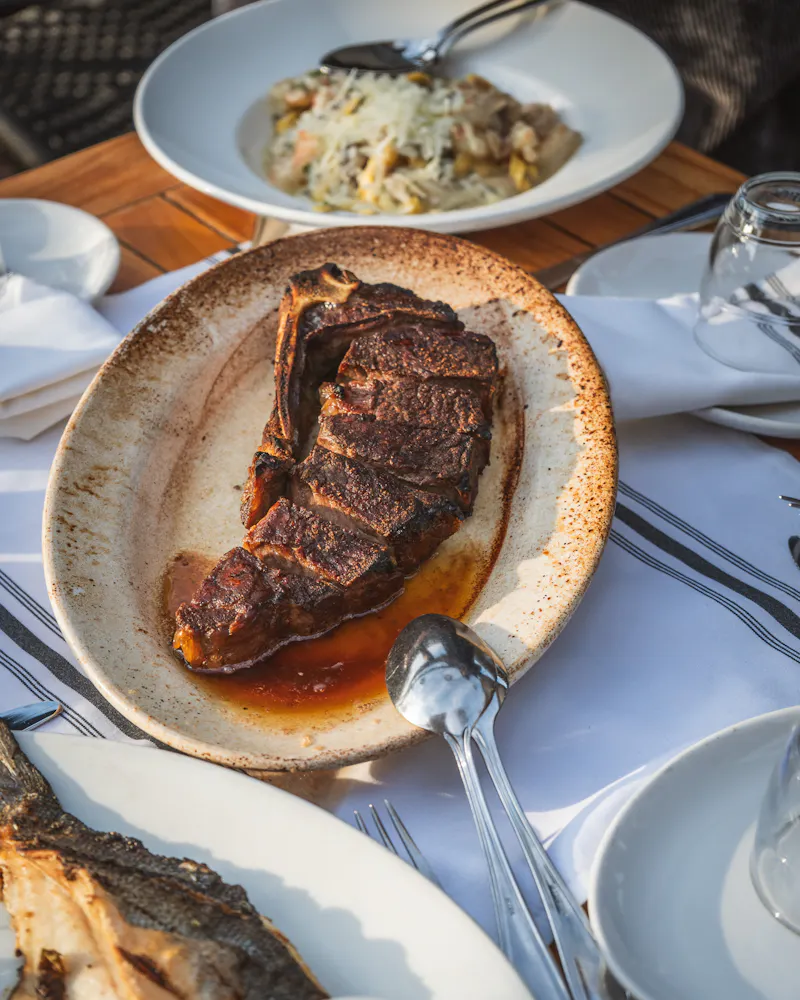
There's a question worth asking before you ever order another steak: what makes one steak a fine dining experience and another one just an expensive piece of meat?
The price tag isn't the answer. A $90 steak at a chain and a $90 steak at a fine dining venue can be different animals — different grades, different aging, different cuts, different kitchens. The chain markup goes mostly to overhead. The fine dining markup goes to the steak itself.
What follows is a clear guide to the four things that separate a fine dining steak from the rest.
Useful whether you're booking a Bergen County anniversary dinner, ordering for a business client, or just want to know what you're paying for the next time the menu says "USDA Prime, dry-aged 28 days."
A note before we start. Most steak content online is either too technical (written for butchers) or too soft (written by marketing teams).
The frame below is the middle path — enough detail that you can use it, not so much that it turns into a textbook.
What "Fine Dining Steak" Means
A fine dining steak isn't a category of beef. It's a combination of four variables, and any single one of them, on its own, isn't enough.
The Four Variables That Decide
A steak earns the fine dining label when all four of these line up:
- Grade: USDA Prime, the top fraction of American beef
- Aging: Dry-aged, usually 21-45 days, in-house or by a serious purveyor
- Cut: A primal cut from the rib, short loin, or tenderloin — not a sirloin tip or a flat iron
- Technique: Cooked over high direct heat (wood-fired oven, broiler, hardwood grill), finished correctly, rested before service
Miss any one and the result drops. A USDA Prime steak that's wet-aged is good but not great.
A dry-aged USDA Choice steak is interesting but lacks the marbling. A great cut handled poorly is a tragedy. The fine dining steak is the version where all four show up at once.
Why Chain Steakhouses Usually Miss
Most well-known chains run USDA Choice or top-end Choice, wet-age in cryovac bags, and cook on a flat-top or in a salamander broiler. None of those choices are wrong for the business model — they're consistent and profitable.
What they aren't is exceptional. If you want to understand the broader difference between casual and fine dining venues, our casual vs. fine dining piece goes deeper on that distinction.
USDA Grading — Why Prime Is the Floor for Fine Dining
USDA grading is the closest thing American beef has to a universal quality standard. It matters more than people realize.
The USDA grades beef into eight categories, but only three show up on restaurant menus: Prime, Choice, and Select.
According to the USDA, the grade is determined by marbling (the intramuscular fat that defines flavor and tenderness) and maturity (the age of the animal). Prime has the most marbling. Choice is a tier below. Select is leaner and tougher.
The Real Numbers
Here's what most diners don't know. USDA Prime accounts for only about 2-3% of all U.S. beef production.
Choice covers around 50-55%. Select covers most of the rest. So when a fine dining menu says "USDA Prime," the kitchen is sourcing from the top fraction of American beef — that's not marketing language, it's a real supply-chain decision the restaurant made.
What Prime Tastes Like vs. Choice
The difference isn't subtle if you've eaten both back-to-back. Prime has more marbling, which means more flavor when the fat renders, and more tenderness because the fat breaks up the muscle fibers.
Choice is leaner. It can still be excellent — a Choice ribeye cooked properly beats a Prime filet mignon cooked badly — but the ceiling is lower. For a fine dining steakhouse, Prime isn't a flex. It's the floor.
Dry-Aging Explained — What It Does and Why It Matters
Dry-aging is one of the clearest signals of a serious steakhouse, and one of the most misunderstood processes in restaurant cooking.
How Dry-Aging Works
Dry-aging is the controlled storage of beef in a temperature- and humidity-regulated room for 21 to 45 days.
As Robb Report describes it, citing butcher Katie Flannery, the process is "a controlled decay" — exposing the beef to oxygen so natural enzymes within the meat break down proteins and connective tissue.
Three things happen during that window:
- Moisture evaporates — the beef loses 15-30% of its weight, concentrating the remaining flavor
- Natural enzymes break down muscle fibers, making the meat more tender
- A flavor-developing crust forms on the outside, which the kitchen trims off before service
The result is a steak with significantly more concentrated, nutty, sometimes funky flavor than the same cut would have fresh.
Dry-Aging vs. Wet-Aging
Here's the divide most diners don't understand. Most American beef is wet-aged in cryovac bags — sitting in its own juices for a few weeks. Wet-aging is cheap, easy, and preserves weight.
Dry-aging is the opposite — it requires a dedicated room, ongoing weight loss the restaurant absorbs as cost, and weeks of inventory tied up in aging beef.
Chain steakhouses generally don't dry-age in-house. A fine dining steakhouse usually does, or sources from a purveyor that does it properly.
How Long Should a Steak Be Dry-Aged?
Different windows produce different flavor profiles. 14-21 days delivers cleaner beef flavor with modest tenderness improvement. 28-35 days is the classic fine dining sweet spot — tender, deeply beefy, modestly funky.
45-60 days produces more pronounced aged flavor that polarizes some diners. Beyond 60 days you get strong blue-cheese funk that's niche territory.
The Cuts That Define a Fine Dining Steakhouse
The cut you order matters as much as the grade and the aging. A fine dining steakhouse offers a specific range because each cut delivers a different experience.
The Core Cuts
- Filet Mignon — the most tender cut, from the tenderloin. Lean, buttery, less aggressive flavor.
- Ribeye — from the rib primal. Heavy marbling, rich flavor, the steak most chefs eat off-duty.
- New York Strip — from the short loin. Balanced — firmer than ribeye, more flavor than filet.
- Porterhouse — a combination cut with both filet and strip, separated by a T-bone. The classic "steak for two."
- Bone-in cuts — bone-in ribeye ("cowboy" or "tomahawk"), bone-in strip. Bone adds flavor during cooking.
What Our Menu Tells You
Sofia's Butcher Shop section reads like a textbook of how a fine dining Italian steakhouse approaches the cut question.
The menu carries Filet Mignon (8 oz and 12 oz, butcher board cut), Porterhouse for two, bone-in Ribeye lollipop, a 14 oz Prime New York Strip, Colorado Lamb Chops, a 16 oz Berkshire double-cut Pork Chop, and Surf & Turf pairing the filet with a half Canadian lobster.
The range matters — different diners want different things, and the right steakhouse meets the table where it is.
Cuts to Skip
Some cuts don't belong on a fine dining menu, even if they're trendy elsewhere — flat iron, hanger, bavette, skirt.
They're great in casual contexts. They're not what you want when you're ordering a fine dining steak. If a menu calling itself fine dining leans heavily on those cuts, the kitchen is signaling something about its priorities.
How a Fine Dining Kitchen Cooks the Steak
Even a perfect cut of dry-aged USDA Prime can be ruined by bad cooking. The technique matters as much as the sourcing.
The Tools
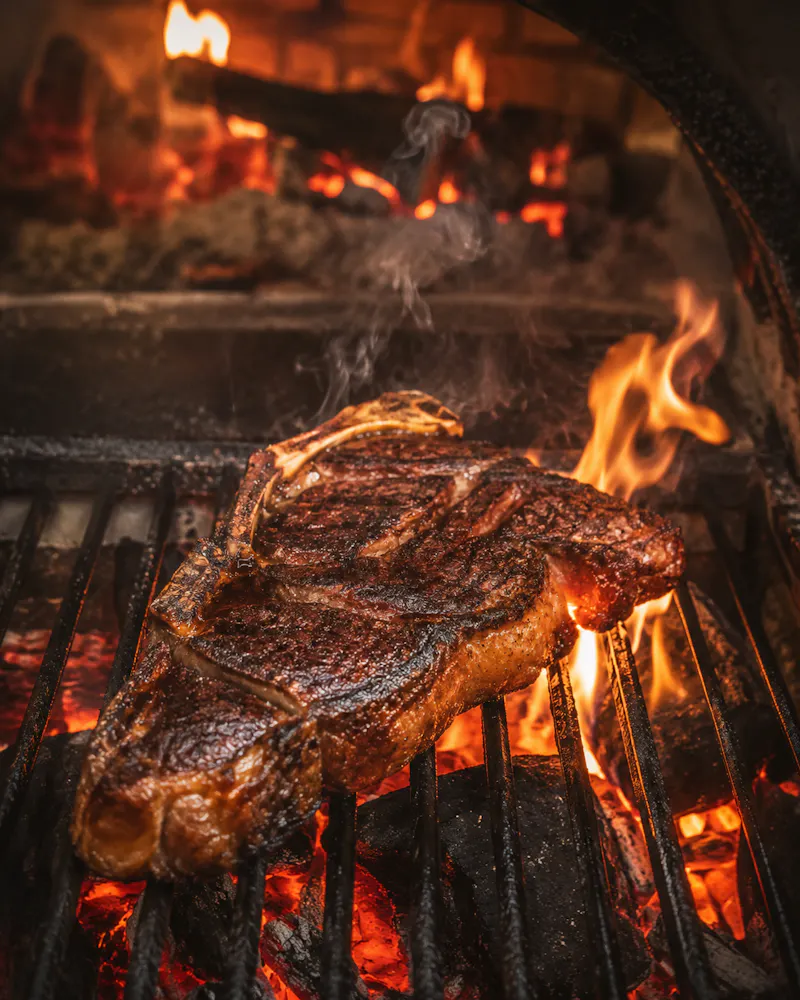
A fine dining steakhouse usually cooks steak on a wood-fired oven or grill, a high-temperature broiler (often 1,200-1,800°F, the New York steakhouse standard), or a hardwood charcoal grill.
What they share is high direct heat, applied quickly, to develop a deep crust before the interior overcooks. A steak cooked on a flat-top griddle, in a pan, or in a low-temperature oven won't develop the crust that defines a serious steak.
How Sofia's Kitchen Handles It
Sofia's Butcher Shop description specifies "wood-fired, hand-selected USDA Prime, dry-aged" steaks.
Wood-fired matters here — the steaks pick up smoke flavor from burning hardwood, develop a deeper crust than a broiler delivers, and finish with a complexity flat-top cooking can't replicate.
Resting the Steak
After cooking, a fine dining kitchen rests the steak for 5-8 minutes before serving. Resting lets the juices redistribute through the meat instead of running out the moment the knife hits the cut. A steak that arrives with juices pooling on the plate hasn't been rested properly.
What to Order — and What to Skip
Knowing the menu architecture helps you order better.
How to Order Doneness
A fine dining steak is best served between medium-rare (130-135°F internal) and medium (135-145°F). Medium-rare is the standard for most cuts — it preserves tenderness and lets fat render without drying the meat.
Medium works for cuts with heavy marbling, like a ribeye, where extra cooking renders more fat into the meat. Order steak well-done at a fine dining steakhouse and you're paying for a premium cut to be cooked into something the kitchen can't deliver at its best.
Cuts Worth Splurging On
A few choices deliver outsized value:
- Porterhouse for two — one cut, two great experiences, shared
- Bone-in ribeye — the bone adds flavor, the cut delivers the most marbling
- Surf & Turf — when the lobster is real and the filet is dry-aged Prime, the pairing earns its place
The Wine and Sides That Belong With the Steak
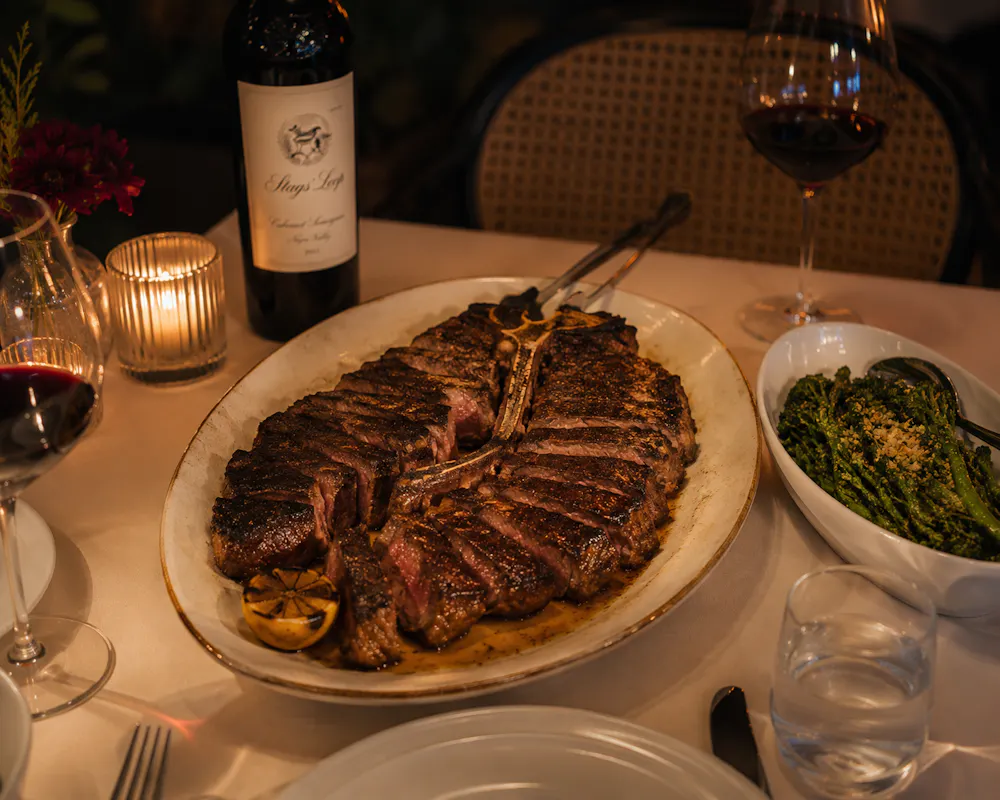
Wine with steak is one of the few pairings that genuinely matters at a fine dining steakhouse.
For a Prime, dry-aged cut, the classic pairings are full-bodied reds — Cabernet Sauvignon, Super Tuscan, Barolo, Brunello.
Sofia's wine list runs deep in all of these directions, with anchors like Sassicaia, Ornellaia, Tignanello, Biondi-Santi Brunello, and serious Napa Cabernet from Caymus, Cakebread, Far Niente, and Joseph Phelps.
Sides to Order
Sides at a fine dining steakhouse are part of the meal, not afterthoughts. The classics — creamed spinach, garlic mashed potatoes, charred Brussels sprouts, broccolini, asparagus and parmigiano, seasonal mushrooms — all earn their place. For a table sharing, two or three sides covers it without over-ordering.
Where Sofia Fits in the Bergen County Fine Dining Scene
Sofia sits at 36 Engle Street in downtown Englewood as a fine dining Italian steakhouse.
Recognized by NJ Digest for "timeless elegance coupled with modern culinary excellence" and a Tripadvisor Travelers' Choice award winner, the kitchen runs USDA Prime, dry-ages its cuts, and finishes them in a wood-fired oven — the three markers that define a real fine dining steak.
Beyond the steak program, the menu carries house-made pasta, daily-flown seafood, raw bar service, caviar (Kaluga and Imperial Ossetra), and a deep Italian-and-American wine list.
The space runs across two floors with a main dining room, the Garden Room with a retractable roof, the Piazza patio, a craft cocktail bar, and a speakeasy-style Cigar Lounge — relevant whether you're booking a first date, a second date, a special birthday, or a business dinner.
Frequently Asked Questions
What is dry-aged steak?
Dry-aged steak is beef that's been stored in a temperature- and humidity-controlled room for 21-45 days, allowing moisture to evaporate and natural enzymes to break down muscle fibers.
The result is a more tender, more concentrated, more complex steak than the same cut would be fresh.
How long is steak dry-aged?
The classic fine dining range is 28-35 days, though some venues go to 45-60 days for more pronounced aged flavor. Anything under 21 days isn't usually called dry-aged in the fine dining sense.
What's the difference between USDA Prime and Choice?
Prime has more marbling, more tenderness, and accounts for roughly 2-3% of U.S. beef production.
Choice has less marbling and accounts for 50-55% of production. Prime is the standard for fine dining steakhouses; Choice is the standard for mid-tier restaurants and grocery stores.
What's the best cut of steak at a fine dining restaurant?
It depends on what you want. Filet mignon for tenderness with subtler flavor. Ribeye for the most marbling and the richest taste.
Porterhouse for the best of both, shared between two. New York strip for balance. Bone-in cuts for added depth.
How should a fine dining steak be cooked?
Medium-rare to medium, on high direct heat (wood-fired oven, broiler, or hardwood grill), with a 5-8 minute rest before serving.
Anything beyond medium starts to undermine the qualities you paid for.
Why is dry-aged steak more expensive?
Three reasons: weight loss during aging (15-30%), trimming losses, and the inventory cost of holding beef for weeks before it can be sold.
Restaurants absorb all of that, and it shows up on the menu price.
Plan Your Fine Dining Steak Dinner at Sofia
A fine dining steak isn't about the markup. It's about the four things working together — Prime grade, dry-aging, the right cut, and a kitchen that knows what to do with all three.
When those four show up at once, you get a steak you remember. When any of them is missing, you get an expensive disappointment.
About Sofia Englewood
Sofia is a fine dining Italian steakhouse in downtown Englewood, NJ. The Butcher Shop menu features wood-fired, hand-selected USDA Prime dry-aged steaks alongside house-made pasta, daily-flown seafood, caviar service, and a curated Italian-and-American wine list.
The two-story space includes a main dining room, the Garden Room with retractable roof, the Piazza patio, and the Cigar Lounge. All-day valet handles arrival.
For reservations and private events, call (201) 541-8530 or book online. Full menus and hours and location are on the site.